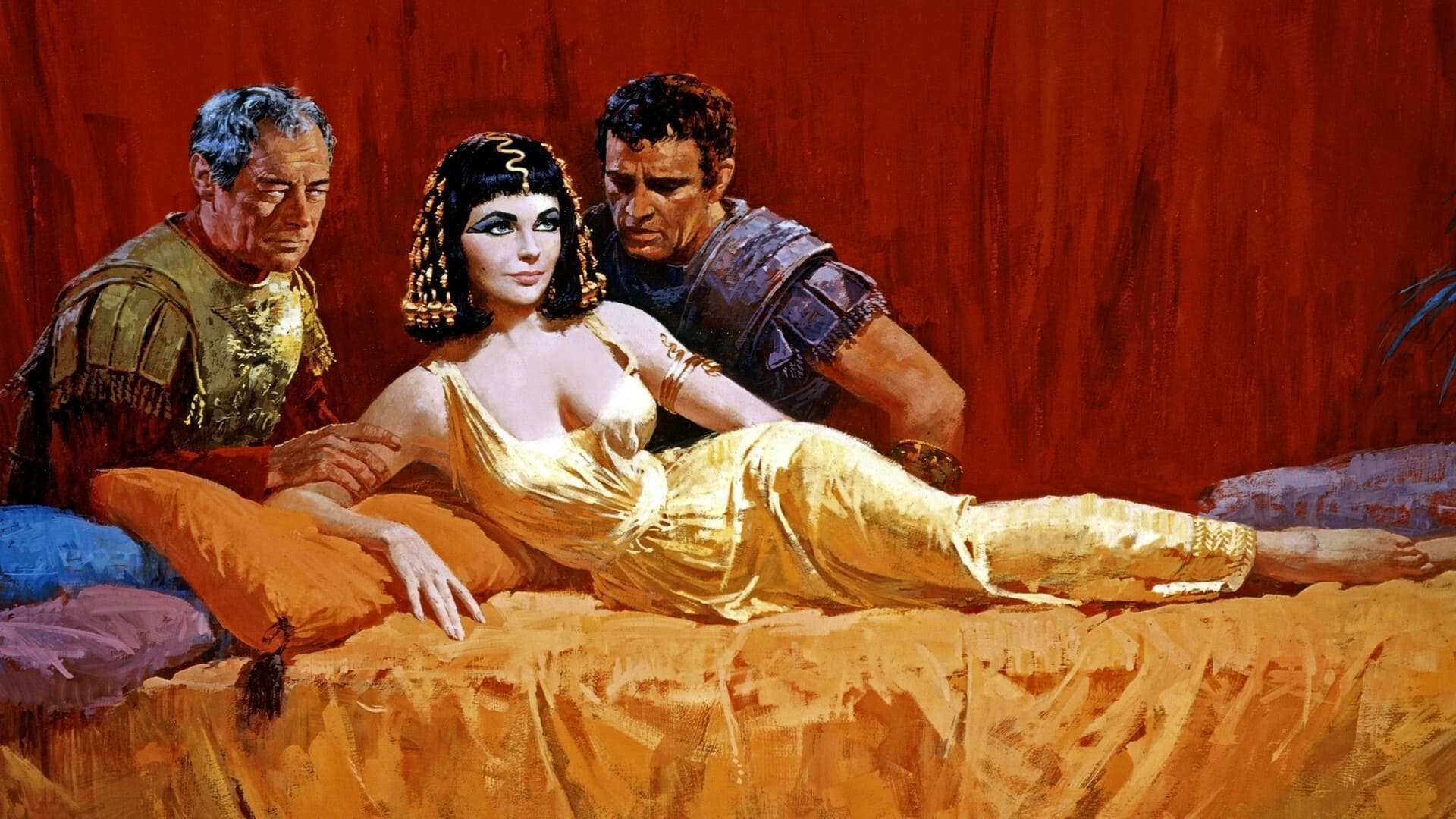
Few films can boast a production as complicated and opulent as Joseph L. Mankiewicz’s Cleopatra .

After more than a century of cinema, there’s no shortage of monster productions with colossal budgets: Titanic, Avengers, Avatar, but in 1963, 20th Century Fox took the riskiest gamble of its existence with Cleopatra.
The film, which after a change of director was awarded to Joseph L. Mankiewicz, was not, however, a huge production from the outset, leading the studio to spend $44 million at the time (over $450 million today). In financial difficulty and in desperate need of a competitive edge, which itself was also struggling against the rising popularity of television in the households and the declining popularity of movie theaters, Fox turned to producer Walter Wanger’s project. Wanger had long had the dream and ambition of offering an epic tale of Cleopatra’s relationship with Julius Caesar, and later with Mark Anthony.
But production costs soon spiraled out of control, while Fox head Spyros Skouras persisted with a grand vision that would save the studio from bankruptcy. To realize this dream, the studio went so far as to write a record-breaking $1 million check for Elizabeth Taylor. While the gigantic sets were being built at Pinewood Studios in England, the first problems arose. Liz Taylor fell chronically ill and was unable to shoot her scenes, while then-director Rouben Mamoulian watched his sets deteriorate in the English rain without being able to shoot any scenes.

As the weeks and months went by and the money kept flowing in, production stalled. After a serious bout of pneumonia that plunged her into a coma, Liz Taylor returned to work, but this time with a new director. Mamoulian was ousted from the production, which was already swelling to several million dollars with only 10 minutes of usable footage. Enter Mankiewicz, who reworks the script from top to bottom, working day and night to ensure every aspect of the film. With this script change also comes a massive casting change, with Richard Burton taking over the role of Mark Anthony and Rex Harrison taking on the role of Julius Caesar, all at a financial cost of several hundred thousand dollars.
All the sets built at Pinewood were eventually destroyed, and rebuilt in Rome at Cinecitta Studios. For his objects, buildings and costumes of unprecedented beauty, finesse and grandiosity, set designer John DeCuir thinks big for his sets. So big, in fact, that the spending records are disguised so as not to alarm the Fox executives in New York about the bottomless pit of money Cleopatra represents.
The press, of course, revels in the film’s production, which feeds the front pages with its folly of grandeur and bills. But before long, a new sensation is feeding the papers, a certain relationship that brings fiction and reality together, that of Elizabeth Taylor and Richard Burton. The two fall in love during production, first in secret and then leaked to the public. Both married, the gossip and paparazzi photographs of the couple in Italy become more important than the 20,000 costumes and thousands of extras present for sequences in the film. Meanwhile, Taylor, who has since far exceeded his original contract time, is paid an extra $70,000 a week.

Mankiewicz, who is fast becoming a jack-of-all-trades, keeps the production running on the weight of his shoulders, with body injections to keep him in shape. While the filmmaker shoots during the day, then continues to write the script at night, the months continue to pass with no finish line in sight. In all his gargantuan, resplendent output, Mankiewicz still manages to film sequences of incomparable majesty, such as Cleopatra’s arrival in Rome, with its dancers, choreography and 10-meter-high Sphinx built just for the sequence.
But time soon ran out, as studio head Spyros Skouras, who turned a blind eye to the film’s staggering expenses, saw his seat ejected to see studio founder Darryl F. Zanuck return. From then on, the money stopped flowing, and the filmmaker had to make do with the remaining money granted to the production to finish shooting, which was still underway in Egypt. After more than two years in production, Cleopatra finished shooting and Mankiewicz began the massive task of editing the film.

It is often said that Cleopatra nearly bankrupted the 20th Century Fox studio, and while Mankiewicz was completing the film’s editing, it was possible to believe it. At Fox studios, no production was underway, every building except Mankiewicz’s was closed, no film other than Cleopatra was in development, the studio’s entire future, both financially and credibly, rested on the film.
Originally, the director had wanted to make two films, Caesar and Cleopatra, and Anthony and Cleopatra, but Zanuck’s pressure to complete the film, and capitalize on Taylor’s relationship with Burton, was too great. The first version of the film clocked in at 5 hours 20 minutes, which was later cut to 3 hours 16 minutes, much to Mankiewicz’s dismay.

Nevertheless, the premiere was preceded by an inescapable buzz around the film, its costumes and make-up flooding the publicity of the time and certifying Cleopatra as the film of the moment. By the end of its 1963 run, the film had grossed almost $22 million, a huge success, but one that paled in comparison with the $44 million spent. Despite winning four Oscars – mainly for its production – it will take several years for the studio to finally turn its lavish production into a profit.
In all her splendor, luxury and magnificence, Cleopatra perfectly embodies the studios’ delusions of grandeur at the time. Ready to do anything to compete with television and bring audiences back into theaters. Like the film, its characters and its shooting, Cleopatra embodies dementia and megalomania. The film’s deviancies served as a lesson not only for Fox, but also for other studios, who preferred to team up before embarking on similar projects.
All Roads Leads to Rome : The Making of Cleopatra (1963), URL : https://elizabethtaylor.com/all-roads-lead-to-rome-the-making-of-cleopatra-1963/
Cleopatra: The Film That Changed Hollywood, Kevin Burns, Brent Zacky, Prometheus Entertainment, 2001.


Leave a Reply